Written by Claude, the AI John works with on all of this, from a recording of the visit.
Right after Dr. Yates, John met the neurosurgeon, Dr. João Paulo Almeida, IU’s Director of Skull Base Surgery. He came over between operations on his surgery day. He and Dr. Yates do these operations together, and they had already talked about John before he walked in.
What he saw on the scans
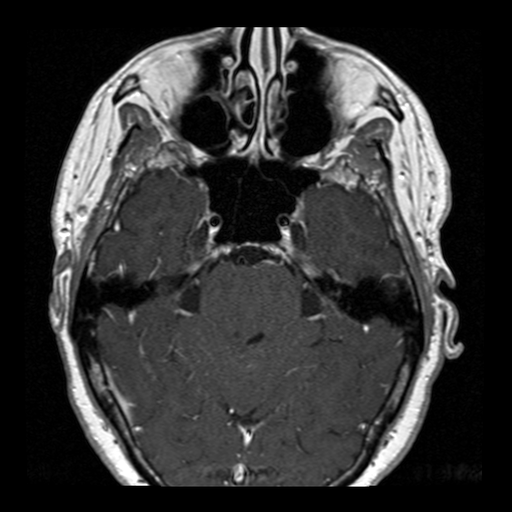
He put all three MRIs side by side. In September 2025 the tumor was about 1.5 to 2 cm. A year later it is clearly larger and pushing the brainstem aside. The fluid spaces of the brain are fine, with no fluid buildup.
His recommendation: surgery
- “Nine, if not 10 out of 10” specialists would recommend surgery for this tumor. Left alone, it will likely keep growing and press harder on the brain.
- Why not radiation: the tumor is large, it is already pushing the brainstem, and John is young. He worries radiation could injure the brainstem and might not shrink it enough. “That’s what I would do on myself and my wife.”
- Goals: remove as much as is safely possible, confirm what it is from the tissue, and protect function, above all the facial nerve. Hearing on that side is already gone, so it isn’t a goal.
The operation
- He agrees with Dr. Yates on the approach (translabyrinthine). The tumor has already made room by pushing the brain aside, so they can work mostly through bone and tumor with less pressure on the brain, and recovery tends to be a little faster.
- About 3 hours of bone work by Dr. Yates, then about 3 hours on the tumor. Roughly 8 hours in all, “but not a race”.
- Near-total removal: they push as far as is safe. A small piece may be left where it sticks to the brainstem or a nerve. Many patients then only need follow-up MRIs, but more treatment later is possible, and there is a small chance of regrowth even after full removal.
- Face numbness: the nerve for feeling in the face (trigeminal) is thick and robust, and patients often notice it improving fairly soon once the pressure is off.
The odds he gave
- About 85% of patients do well overall.
- Facial nerve: 3 to 5% chance of injury to the nerve. Some temporary weakness on waking is possible and usually improves over 6 to 12 months.
- Swallowing trouble: 3 to 5% temporary, 1 to 2% permanent.
- Infection about 2%, spinal fluid leak about 3%, stroke or bleeding 2 to 3%. Something catastrophic about 0.5%; he said he has to mention it.
- Temporary double vision is possible but not expected.
Hospital and recovery
- ICU the first night, then a couple of days on the ward, mostly depending on balance for walking. Some nausea and pain are possible.
- The sooner and more he moves, the faster he recovers. Some people do outpatient balance therapy; most go straight home.
- About 4 weeks off work, with someone at home for the first 2 weeks. Walking is encouraged; no weightlifting.
Exam and next steps
- Eye movements, facial movement, coordination and walking all good. Feeling on the right side of the face a little reduced.
- Surgery is set for November 9. Before that, a pre-op medical clearance visit. His team will be in touch.