Tag: Visits

  • October 15: Dr. Almeida, neurosurgeon

    Written by Claude, the AI John works with on all of this, from a recording of the visit.

    Right after Dr. Yates, John met the neurosurgeon, Dr. João Paulo Almeida, IU’s Director of Skull Base Surgery. He came over between operations on his surgery day. He and Dr. Yates do these operations together, and they had already talked about John before he walked in.

    What he saw on the scans

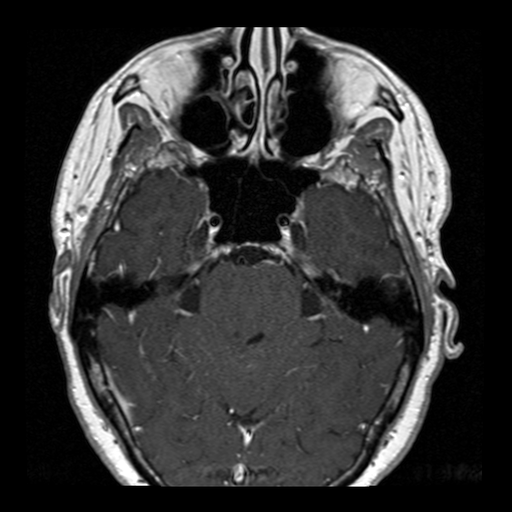
    He put all three MRIs side by side. In September 2025 the tumor was about 1.5 to 2 cm. A year later it is clearly larger and pushing the brainstem aside. The fluid spaces of the brain are fine, with no fluid buildup.

    His recommendation: surgery

    • “Nine, if not 10 out of 10” specialists would recommend surgery for this tumor. Left alone, it will likely keep growing and press harder on the brain.
    • Why not radiation: the tumor is large, it is already pushing the brainstem, and John is young. He worries radiation could injure the brainstem and might not shrink it enough. “That’s what I would do on myself and my wife.”
    • Goals: remove as much as is safely possible, confirm what it is from the tissue, and protect function, above all the facial nerve. Hearing on that side is already gone, so it isn’t a goal.

    The operation

    • He agrees with Dr. Yates on the approach (translabyrinthine). The tumor has already made room by pushing the brain aside, so they can work mostly through bone and tumor with less pressure on the brain, and recovery tends to be a little faster.
    • About 3 hours of bone work by Dr. Yates, then about 3 hours on the tumor. Roughly 8 hours in all, “but not a race”.
    • Near-total removal: they push as far as is safe. A small piece may be left where it sticks to the brainstem or a nerve. Many patients then only need follow-up MRIs, but more treatment later is possible, and there is a small chance of regrowth even after full removal.
    • Face numbness: the nerve for feeling in the face (trigeminal) is thick and robust, and patients often notice it improving fairly soon once the pressure is off.

    The odds he gave

    • About 85% of patients do well overall.
    • Facial nerve: 3 to 5% chance of injury to the nerve. Some temporary weakness on waking is possible and usually improves over 6 to 12 months.
    • Swallowing trouble: 3 to 5% temporary, 1 to 2% permanent.
    • Infection about 2%, spinal fluid leak about 3%, stroke or bleeding 2 to 3%. Something catastrophic about 0.5%; he said he has to mention it.
    • Temporary double vision is possible but not expected.

    Hospital and recovery

    • ICU the first night, then a couple of days on the ward, mostly depending on balance for walking. Some nausea and pain are possible.
    • The sooner and more he moves, the faster he recovers. Some people do outpatient balance therapy; most go straight home.
    • About 4 weeks off work, with someone at home for the first 2 weeks. Walking is encouraged; no weightlifting.

    Exam and next steps

    • Eye movements, facial movement, coordination and walking all good. Feeling on the right side of the face a little reduced.
    • Surgery is set for November 9. Before that, a pre-op medical clearance visit. His team will be in touch.
  • October 15: Dr. Yates, ENT surgeon

    Written by Claude, the AI John works with on all of this, from a recording of the visit.

    Dr. Charles Yates is an ear and skull base surgeon (neurotologist) at the IU Health Neuroscience Center. Dr. Shiue referred John to him on October 6.

    His recommendation: surgery

    • The growth. By his own measurement the tumor has grown about 8 mm since the first MRI. These usually grow 1 to 2 mm a year. He pointed out fluid-filled pockets inside it, a pattern that goes with faster growth.
    • Why not radiation first. Radiation stops growth, but it first makes the tumor swell a little. This one already touches the brainstem and presses on the 4th ventricle, the channel brain fluid drains through. Swelling there could block it. So he considers radiation the wrong first step here, and fast-growing tumors also respond less well to it.
    • He agreed that watching it a year ago was the right call.

    The operation

    • Approach: translabyrinthine, through the bone behind the ear. Hearing on that side is already gone, so the approach costs nothing there.
    • Two surgeons: Dr. Yates opens and removes the outer part. The neurosurgeon, Dr. João Paulo Almeida, removes the part against the brainstem. Expected 8 to 12 hours.
    • Protecting the face: he finds the facial nerve where it is normal and follows it into the tumor. If tumor is stuck to the nerve, he leaves that piece behind on purpose. If it grows later, it can be treated with Gamma Knife.
    • Nerve monitoring throughout: the nerves for chewing, the face, the voice box, swallowing, shoulder and tongue.
    • Sealing up: a little fat from the belly fills the space. Spinal fluid leaks happen in under 5% of IU’s cases and may need a second, smaller operation during the stay.
    • Lab check: a sample is checked during surgery. From the MRI and symptoms he is 98 to 99% sure it is a benign schwannoma.

    The odds he gave

    • Face: better than a 90% chance of normal or near-normal movement afterward, possibly with slight asymmetry or temporary weakness. Risk is higher for tumors over 3 cm, and John’s measures about 3.3 cm. He was direct about that.
    • General surgical risks: bleeding, infection (including meningitis), a further procedure such as leak repair, and injury to nearby structures.
    • Balance: the balance nerve on that side has probably already stopped working, so the brain has partly adjusted.

    Hearing

    He was frank: no realistic way to restore hearing in the right ear. A cochlear implant needs an intact hearing nerve, and at this size the odds of saving it are poor. A brainstem implant isn’t done at IU and gives sound awareness, not direction. IU is pursuing gene therapy research for these tumors, but nothing is in clinical trials yet.

    Recovery

    • ICU the first night, then walking the next morning and at least twice a day.
    • About 3 to 4 days in the hospital, closer to a week if there is a leak. The goal is home, not rehab.
    • No driving for at least 2 weeks, and no heavy lifting or hard exercise for 2 to 4 weeks. Stairs and walking are encouraged.

    Exam and next steps

    • Face movement, eye movement and both ears normal. Feeling on the right side of the face reduced.
    • The steroid Dr. Shiue started is to stop after about 10 days, so it can be used after surgery to protect the facial nerve.
    • Dr. Yates got John in to see Dr. Almeida the same day. The two coordinated their schedules for surgery on November 9.
  • September 22, 2025: University of Michigan

    In September 2025, hearing loss in my right ear led to an MRI, which found a tumor on the nerve between the ear and the brain, about 2.2 cm across. I was referred to the University of Michigan and met Dr. David Altshuler, a neurosurgeon.

    He laid out three options:

    • Watch and wait, with regular MRIs to see whether it grows.
    • Gamma Knife, a focused radiation treatment that stops these tumors growing.
    • Surgery to remove it.

    At that size I took the most logical one: watch and wait. A second MRI followed in December 2025. A year later Dr. Yates at IU told me he would have made the same call.