Go big or goWent big. CameHome
-
November 14: Went big. Now I’m HOME.
Well, I went big. And now I’m home!
Monday, November 9th was every bit the all-day affair we were promised. I checked in at IU Health Methodist in Indianapolis at 7:30 in the morning and didn’t land in the ICU until about 10:30 that night. It took six anesthesiologists working in shifts to keep me under. I had the easy job. I slept through the whole thing. Kim and the family had the hard one: waiting.
The short version, for those of you who skip to the end of the book: it went as planned, there were no complications, and the “patient” in me who was frankly scared going in is very, very relieved.
The Long Day
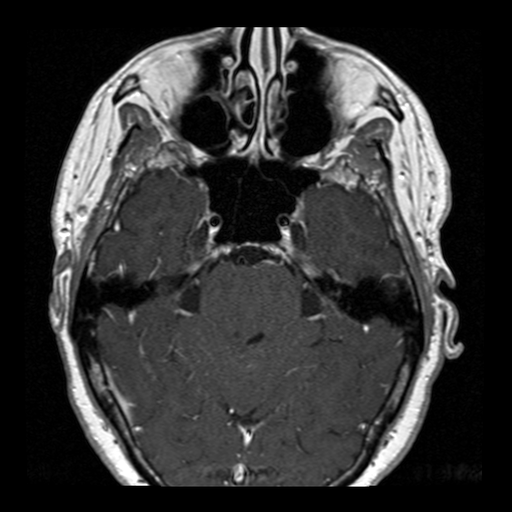
My two surgeons ran it like a relay. Dr. Yates went first, working his way in through the bone behind my right ear to reach the tumor. Then Dr. Almeida took over for the delicate part: hollowing the tumor out from the inside and peeling it away from my brainstem and the nerves around it. It was stuck to pretty much everything it touched, which is a big part of why the day ran so long.
They removed nearly all of it. The one exception was on purpose. The tumor was wrapped around my facial nerve (the one that moves the right side of my face), and rather than risk that nerve, they left a microscopic layer behind on it. That was the plan going in, and it worked.
How they protected that nerve is the part that fascinates me. Before the first cut, a separate team wired my face up with tiny electrodes, so that any time the nerve fired, a machine in the room would know about it. From then on the surgeons carried a pencil-sized probe that puts out a very small electrical current. Touch it to the facial nerve and my face twitches and the monitor answers. Touch it to tumor and nothing happens.
So they used it like a stud finder. Dr. Yates tested it first on a spot where he could see the nerve, to prove the whole system was working, and got what his notes call a “robust response.” Before Dr. Almeida cut into the tumor, he swept the probe across its back surface to make sure the nerve wasn’t hiding there. It wasn’t. Then, as he peeled the tumor away, he kept checking, over and over. In his words, “we stimulated as we dissected.” All day long.
The final exam came at the very end. A healthy nerve answers to a whisper; a damaged one needs a shout. Mine was still answering at 0.05 milliamps, five hundredths of a milliamp, which is about as quiet a whisper as they use. The notes call the nerve “electrically and anatomically intact.” By the next morning my face was moving, graded a 1 to 2 on a 6-point scale where 1 is perfectly normal. Of all the outcomes I worried about, that was the big one.
The pressure on my brainstem is gone, and the numbness on the right side of my face was already easing the next day.
Then Dr. Yates closed everything up, and here’s a detail I can’t keep to myself. To seal the opening, they borrowed a little fat from my belly, and his notes say it was packed in “as a champagne cork.” So I came home with a second, smaller incision and, apparently, a cork in my head. Insert your own joke here.
Now the trade-offs, none of them a surprise. The hearing in my right ear is gone for good. It had already left the building last year, so this mostly makes it official. The balance organ on that side had to go too, since that’s the road they took in. That leaves my left ear in charge of both hearing and keeping me upright, and it has some learning to do.
The Hospital
Because the surgery ran so long, they left the breathing tube in overnight and took it out Tuesday morning. (If I sound a little hoarse on the phone, that’s why.) Later that morning Dr. Almeida stopped by and told us he was “overall very happy with the result.” So am I!
The plan called for three or four days in the hospital. I was out in two. The only holdup on Wednesday was my walker: the delivery couldn’t get it there in time, so my case manager personally tracked one down so we could leave. Kim had me home that afternoon.
And on Thursday the lab report came in: a schwannoma, WHO grade 1. That’s the lowest grade there is. In plain English, it was exactly the benign, slow-growing tumor everyone expected, and it is not cancer. We were told that all along, but it sure is good to have it in writing.
Home
My marching orders start with walking a mile a day, because walking is how the brain learns to balance on one ear. I’ll be honest: right now the mile may as well be a joke. It’s cold outside, and the house is not big enough to hold a mile. I’m getting around as much as I can, though.
The rest of the list is easier. Lift nothing heavier than a gallon of milk. No driving for a few weeks. No nose blowing for four weeks, and if I have to sneeze, I’m to do it with my mouth open. (You’ve been warned.) No pools, lakes or hot tubs, which in Indiana in November is a sacrifice I’m prepared to make.
My favorite line in the discharge papers: housework and yard work are “not permitted” until my first follow-up visit. That specifically includes vacuuming and mowing. I’m thinking about having it framed.
From here it’s rest, walking, and a handful of dates. My first follow-up is this Tuesday, November 17, and I see Dr. Yates again on December 4. I’ll probably be off work for four to six weeks. In February, a new MRI becomes the baseline we compare against from here on. And in March there’s a hearing test, where we start talking about what can be done for the right side.
Kudos
Thank you for every note in the guestbook, every text and every prayer. I’ve read them all, some of them twice.
Before surgery I wrote that I couldn’t feel more confident in my care team. Consider this a big nod of confidence after the fact: it was well placed. Dr. Almeida and Dr. Yates did exactly what they said they would do. Dr. Adam Xiao, who operated alongside Dr. Yates, was always a friendly face coming around to check on me afterwards.
Then there are the people I never met awake: the anesthesiologists, the team that watched that nerve monitor all day, and the lab that gave us the good news in writing. Add the ICU and floor nurses who looked after me around the clock, and the case manager who refused to let a missing walker keep me from going home. Thank you, all of you.
And then there’s my home care team. Macy and Morgan endured the whole hospital stay, right along with the moms, the dads and lots of aunts. Lots and lots of aunts. 🙂 I got to sleep through the long day. They had to sit through it.
And Kim. Kim has been at my side 24/7, before, during and every minute since. To her, my loving thanks.
Research & Results has the full details: scans, measurements and research. Notes from each visit are below, newest first.
The Care Team: Dr. Charles Yates | Dr. João Paulo Almeida | Dr. Kevin Shiue
Visit notes, newest first
-
November 3: Go big or go home
What’s that saying? Go big or go home! On Monday, November 9th, I am headed to the IU Neuroscience Center in Indianapolis for what is anticipated to be a 10-to-12-hour surgery to remove a 3 cm tumor that has grown…
-
October 22: Pre-op testing is on the calendar
Today I booked my pre-admission testing visit at IU Health Methodist Hospital in Indianapolis, for next Tuesday, October 27. It’s a short appointment, about 40 minutes. It’s where the hospital checks I’m ready for a long surgery: they go over…
-
October 15: Dr. Almeida, neurosurgeon
Written by Claude, the AI John works with on all of this, from a recording of the visit. Right after Dr. Yates, John met the neurosurgeon, Dr. João Paulo Almeida, IU’s Director of Skull Base Surgery. He came over between…
-
October 15: Dr. Yates, ENT surgeon
Written by Claude, the AI John works with on all of this, from a recording of the visit. Dr. Charles Yates is an ear and skull base surgeon (neurotologist) at the IU Health Neuroscience Center. Dr. Shiue referred John to…
-
September 22, 2025: University of Michigan
In September 2025, hearing loss in my right ear led to an MRI, which found a tumor on the nerve between the ear and the brain, about 2.2 cm across. I was referred to the University of Michigan and met…