Category: Updates

  • November 14: Went big. Now I’m HOME.

    Well, I went big. And now I’m home!

    Monday, November 9th was every bit the all-day affair we were promised. I checked in at IU Health Methodist in Indianapolis at 7:30 in the morning and didn’t land in the ICU until about 10:30 that night. It took six anesthesiologists working in shifts to keep me under. I had the easy job. I slept through the whole thing. Kim and the family had the hard one: waiting.

    The short version, for those of you who skip to the end of the book: it went as planned, there were no complications, and the “patient” in me who was frankly scared going in is very, very relieved.

    The Long Day

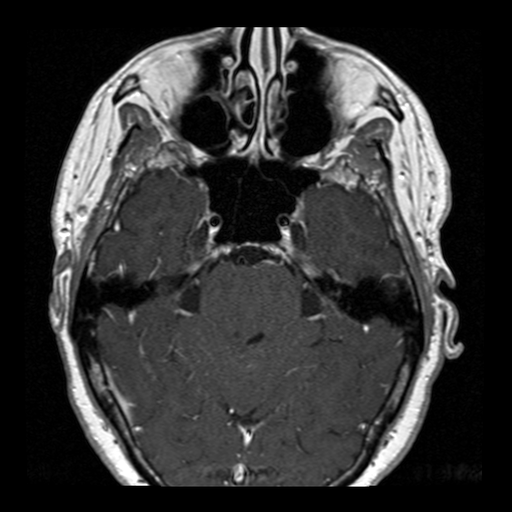
    My two surgeons ran it like a relay. Dr. Yates went first, working his way in through the bone behind my right ear to reach the tumor. Then Dr. Almeida took over for the delicate part: hollowing the tumor out from the inside and peeling it away from my brainstem and the nerves around it. It was stuck to pretty much everything it touched, which is a big part of why the day ran so long.

    They removed nearly all of it. The one exception was on purpose. The tumor was wrapped around my facial nerve (the one that moves the right side of my face), and rather than risk that nerve, they left a microscopic layer behind on it. That was the plan going in, and it worked.

    How they protected that nerve is the part that fascinates me. Before the first cut, a separate team wired my face up with tiny electrodes, so that any time the nerve fired, a machine in the room would know about it. From then on the surgeons carried a pencil-sized probe that puts out a very small electrical current. Touch it to the facial nerve and my face twitches and the monitor answers. Touch it to tumor and nothing happens.

    So they used it like a stud finder. Dr. Yates tested it first on a spot where he could see the nerve, to prove the whole system was working, and got what his notes call a “robust response.” Before Dr. Almeida cut into the tumor, he swept the probe across its back surface to make sure the nerve wasn’t hiding there. It wasn’t. Then, as he peeled the tumor away, he kept checking, over and over. In his words, “we stimulated as we dissected.” All day long.

    The final exam came at the very end. A healthy nerve answers to a whisper; a damaged one needs a shout. Mine was still answering at 0.05 milliamps, five hundredths of a milliamp, which is about as quiet a whisper as they use. The notes call the nerve “electrically and anatomically intact.” By the next morning my face was moving, graded a 1 to 2 on a 6-point scale where 1 is perfectly normal. Of all the outcomes I worried about, that was the big one.

    The pressure on my brainstem is gone, and the numbness on the right side of my face was already easing the next day.

    Then Dr. Yates closed everything up, and here’s a detail I can’t keep to myself. To seal the opening, they borrowed a little fat from my belly, and his notes say it was packed in “as a champagne cork.” So I came home with a second, smaller incision and, apparently, a cork in my head. Insert your own joke here.

    Now the trade-offs, none of them a surprise. The hearing in my right ear is gone for good. It had already left the building last year, so this mostly makes it official. The balance organ on that side had to go too, since that’s the road they took in. That leaves my left ear in charge of both hearing and keeping me upright, and it has some learning to do.

    The Hospital

    Because the surgery ran so long, they left the breathing tube in overnight and took it out Tuesday morning. (If I sound a little hoarse on the phone, that’s why.) Later that morning Dr. Almeida stopped by and told us he was “overall very happy with the result.” So am I!

    The plan called for three or four days in the hospital. I was out in two. The only holdup on Wednesday was my walker: the delivery couldn’t get it there in time, so my case manager personally tracked one down so we could leave. Kim had me home that afternoon.

    And on Thursday the lab report came in: a schwannoma, WHO grade 1. That’s the lowest grade there is. In plain English, it was exactly the benign, slow-growing tumor everyone expected, and it is not cancer. We were told that all along, but it sure is good to have it in writing.

    Home

    My marching orders start with walking a mile a day, because walking is how the brain learns to balance on one ear. I’ll be honest: right now the mile may as well be a joke. It’s cold outside, and the house is not big enough to hold a mile. I’m getting around as much as I can, though.

    The rest of the list is easier. Lift nothing heavier than a gallon of milk. No driving for a few weeks. No nose blowing for four weeks, and if I have to sneeze, I’m to do it with my mouth open. (You’ve been warned.) No pools, lakes or hot tubs, which in Indiana in November is a sacrifice I’m prepared to make.

    My favorite line in the discharge papers: housework and yard work are “not permitted” until my first follow-up visit. That specifically includes vacuuming and mowing. I’m thinking about having it framed.

    From here it’s rest, walking, and a handful of dates. My first follow-up is this Tuesday, November 17, and I see Dr. Yates again on December 4. I’ll probably be off work for four to six weeks. In February, a new MRI becomes the baseline we compare against from here on. And in March there’s a hearing test, where we start talking about what can be done for the right side.

    Kudos

    Thank you for every note in the guestbook, every text and every prayer. I’ve read them all, some of them twice.

    Before surgery I wrote that I couldn’t feel more confident in my care team. Consider this a big nod of confidence after the fact: it was well placed. Dr. Almeida and Dr. Yates did exactly what they said they would do. Dr. Adam Xiao, who operated alongside Dr. Yates, was always a friendly face coming around to check on me afterwards.

    Then there are the people I never met awake: the anesthesiologists, the team that watched that nerve monitor all day, and the lab that gave us the good news in writing. Add the ICU and floor nurses who looked after me around the clock, and the case manager who refused to let a missing walker keep me from going home. Thank you, all of you.

    And then there’s my home care team. Macy and Morgan endured the whole hospital stay, right along with the moms, the dads and lots of aunts. Lots and lots of aunts. 🙂 I got to sleep through the long day. They had to sit through it.

    And Kim. Kim has been at my side 24/7, before, during and every minute since. To her, my loving thanks.

  • November 3: Go big or go home

    What’s that saying? Go big or go home!

    On Monday, November 9th, I am headed to the IU Neuroscience Center in Indianapolis for what is anticipated to be a 10-to-12-hour surgery to remove a 3 cm tumor that has grown on the nerve that controls hearing and balance on my right side. In short, a full-on craniotomy!

    The Timeline

    In September 2025, over the span of a long weekend, the hearing in my right ear vanished. Now, it was obvious to me in the months preceding that something was going on, as I had found myself saying “What?” a lot more, but it made more sense to chalk it up to being in and around the live music scene, as well as just getting older. Strangely, going from 100% to 10% was noticeable but not alarming. But going from 10% to zero has changed my world forever.

    Because my hearing was permanently gone, and these tumors typically grow slowly (1–2 mm/yr), the “watch and wait” approach seemed like the best option.

    Fast-forward to this summer: I started to lose sensation, taste, and smell on my right side, which was a clear sign that “watch and wait” had officially ended. The tumor had grown almost a full centimeter since my first MRI, and new scans indicated that it was starting to press in on the brain stem and had the potential to compromise the other cranial nerves.

    So, here I go! It’s beyond surreal to me. Part of me thinks of all the folks (and their loved ones) who have faced obstacles far greater than this in dealing with their quality of life and health issues. I should be, and am, thankful despite this setback. But there is also the “patient” in me that is frankly scared to face this surgery, along with its risks and potential irreversible outcomes.

    I had the opportunity to meet with both surgeons a couple of weeks ago, and I couldn’t feel more confident in my care team.

  • October 22: Pre-op testing is on the calendar

    Today I booked my pre-admission testing visit at IU Health Methodist Hospital in Indianapolis, for next Tuesday, October 27.

    It’s a short appointment, about 40 minutes. It’s where the hospital checks I’m ready for a long surgery: they go over my medications and health history, and do whatever tests the anesthesia team wants before November 9.

    Up to now the surgery date has felt like a line on a calendar. Having the pre-op visit booked makes it real. November 9 is happening.

    I’ll post again after Tuesday’s visit.

  • October 15: Dr. Almeida, neurosurgeon

    Written by Claude, the AI John works with on all of this, from a recording of the visit.

    Right after Dr. Yates, John met the neurosurgeon, Dr. João Paulo Almeida, IU’s Director of Skull Base Surgery. He came over between operations on his surgery day. He and Dr. Yates do these operations together, and they had already talked about John before he walked in.

    What he saw on the scans

    He put all three MRIs side by side. In September 2025 the tumor was about 1.5 to 2 cm. A year later it is clearly larger and pushing the brainstem aside. The fluid spaces of the brain are fine, with no fluid buildup.

    His recommendation: surgery

    • “Nine, if not 10 out of 10” specialists would recommend surgery for this tumor. Left alone, it will likely keep growing and press harder on the brain.
    • Why not radiation: the tumor is large, it is already pushing the brainstem, and John is young. He worries radiation could injure the brainstem and might not shrink it enough. “That’s what I would do on myself and my wife.”
    • Goals: remove as much as is safely possible, confirm what it is from the tissue, and protect function, above all the facial nerve. Hearing on that side is already gone, so it isn’t a goal.

    The operation

    • He agrees with Dr. Yates on the approach (translabyrinthine). The tumor has already made room by pushing the brain aside, so they can work mostly through bone and tumor with less pressure on the brain, and recovery tends to be a little faster.
    • About 3 hours of bone work by Dr. Yates, then about 3 hours on the tumor. Roughly 8 hours in all, “but not a race”.
    • Near-total removal: they push as far as is safe. A small piece may be left where it sticks to the brainstem or a nerve. Many patients then only need follow-up MRIs, but more treatment later is possible, and there is a small chance of regrowth even after full removal.
    • Face numbness: the nerve for feeling in the face (trigeminal) is thick and robust, and patients often notice it improving fairly soon once the pressure is off.

    The odds he gave

    • About 85% of patients do well overall.
    • Facial nerve: 3 to 5% chance of injury to the nerve. Some temporary weakness on waking is possible and usually improves over 6 to 12 months.
    • Swallowing trouble: 3 to 5% temporary, 1 to 2% permanent.
    • Infection about 2%, spinal fluid leak about 3%, stroke or bleeding 2 to 3%. Something catastrophic about 0.5%; he said he has to mention it.
    • Temporary double vision is possible but not expected.

    Hospital and recovery

    • ICU the first night, then a couple of days on the ward, mostly depending on balance for walking. Some nausea and pain are possible.
    • The sooner and more he moves, the faster he recovers. Some people do outpatient balance therapy; most go straight home.
    • About 4 weeks off work, with someone at home for the first 2 weeks. Walking is encouraged; no weightlifting.

    Exam and next steps

    • Eye movements, facial movement, coordination and walking all good. Feeling on the right side of the face a little reduced.
    • Surgery is set for November 9. Before that, a pre-op medical clearance visit. His team will be in touch.
  • October 15: Dr. Yates, ENT surgeon

    Written by Claude, the AI John works with on all of this, from a recording of the visit.

    Dr. Charles Yates is an ear and skull base surgeon (neurotologist) at the IU Health Neuroscience Center. Dr. Shiue referred John to him on October 6.

    His recommendation: surgery

    • The growth. By his own measurement the tumor has grown about 8 mm since the first MRI. These usually grow 1 to 2 mm a year. He pointed out fluid-filled pockets inside it, a pattern that goes with faster growth.
    • Why not radiation first. Radiation stops growth, but it first makes the tumor swell a little. This one already touches the brainstem and presses on the 4th ventricle, the channel brain fluid drains through. Swelling there could block it. So he considers radiation the wrong first step here, and fast-growing tumors also respond less well to it.
    • He agreed that watching it a year ago was the right call.

    The operation

    • Approach: translabyrinthine, through the bone behind the ear. Hearing on that side is already gone, so the approach costs nothing there.
    • Two surgeons: Dr. Yates opens and removes the outer part. The neurosurgeon, Dr. João Paulo Almeida, removes the part against the brainstem. Expected 8 to 12 hours.
    • Protecting the face: he finds the facial nerve where it is normal and follows it into the tumor. If tumor is stuck to the nerve, he leaves that piece behind on purpose. If it grows later, it can be treated with Gamma Knife.
    • Nerve monitoring throughout: the nerves for chewing, the face, the voice box, swallowing, shoulder and tongue.
    • Sealing up: a little fat from the belly fills the space. Spinal fluid leaks happen in under 5% of IU’s cases and may need a second, smaller operation during the stay.
    • Lab check: a sample is checked during surgery. From the MRI and symptoms he is 98 to 99% sure it is a benign schwannoma.

    The odds he gave

    • Face: better than a 90% chance of normal or near-normal movement afterward, possibly with slight asymmetry or temporary weakness. Risk is higher for tumors over 3 cm, and John’s measures about 3.3 cm. He was direct about that.
    • General surgical risks: bleeding, infection (including meningitis), a further procedure such as leak repair, and injury to nearby structures.
    • Balance: the balance nerve on that side has probably already stopped working, so the brain has partly adjusted.

    Hearing

    He was frank: no realistic way to restore hearing in the right ear. A cochlear implant needs an intact hearing nerve, and at this size the odds of saving it are poor. A brainstem implant isn’t done at IU and gives sound awareness, not direction. IU is pursuing gene therapy research for these tumors, but nothing is in clinical trials yet.

    Recovery

    • ICU the first night, then walking the next morning and at least twice a day.
    • About 3 to 4 days in the hospital, closer to a week if there is a leak. The goal is home, not rehab.
    • No driving for at least 2 weeks, and no heavy lifting or hard exercise for 2 to 4 weeks. Stairs and walking are encouraged.

    Exam and next steps

    • Face movement, eye movement and both ears normal. Feeling on the right side of the face reduced.
    • The steroid Dr. Shiue started is to stop after about 10 days, so it can be used after surgery to protect the facial nerve.
    • Dr. Yates got John in to see Dr. Almeida the same day. The two coordinated their schedules for surgery on November 9.
  • September 22, 2025: University of Michigan

    In September 2025, hearing loss in my right ear led to an MRI, which found a tumor on the nerve between the ear and the brain, about 2.2 cm across. I was referred to the University of Michigan and met Dr. David Altshuler, a neurosurgeon.

    He laid out three options:

    • Watch and wait, with regular MRIs to see whether it grows.
    • Gamma Knife, a focused radiation treatment that stops these tumors growing.
    • Surgery to remove it.

    At that size I took the most logical one: watch and wait. A second MRI followed in December 2025. A year later Dr. Yates at IU told me he would have made the same call.