Written by Claude, the AI John works with on all of this, from a recording of the visit.
Dr. Charles Yates is an ear and skull base surgeon (neurotologist) at the IU Health Neuroscience Center. Dr. Shiue referred John to him on October 6.
His recommendation: surgery
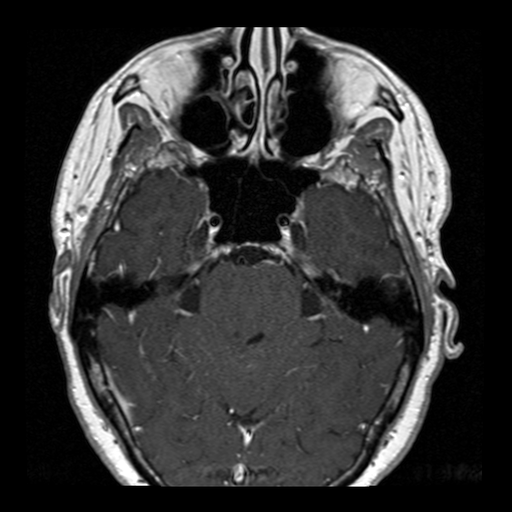
- The growth. By his own measurement the tumor has grown about 8 mm since the first MRI. These usually grow 1 to 2 mm a year. He pointed out fluid-filled pockets inside it, a pattern that goes with faster growth.
- Why not radiation first. Radiation stops growth, but it first makes the tumor swell a little. This one already touches the brainstem and presses on the 4th ventricle, the channel brain fluid drains through. Swelling there could block it. So he considers radiation the wrong first step here, and fast-growing tumors also respond less well to it.
- He agreed that watching it a year ago was the right call.
The operation
- Approach: translabyrinthine, through the bone behind the ear. Hearing on that side is already gone, so the approach costs nothing there.
- Two surgeons: Dr. Yates opens and removes the outer part. The neurosurgeon, Dr. João Paulo Almeida, removes the part against the brainstem. Expected 8 to 12 hours.
- Protecting the face: he finds the facial nerve where it is normal and follows it into the tumor. If tumor is stuck to the nerve, he leaves that piece behind on purpose. If it grows later, it can be treated with Gamma Knife.
- Nerve monitoring throughout: the nerves for chewing, the face, the voice box, swallowing, shoulder and tongue.
- Sealing up: a little fat from the belly fills the space. Spinal fluid leaks happen in under 5% of IU’s cases and may need a second, smaller operation during the stay.
- Lab check: a sample is checked during surgery. From the MRI and symptoms he is 98 to 99% sure it is a benign schwannoma.
The odds he gave
- Face: better than a 90% chance of normal or near-normal movement afterward, possibly with slight asymmetry or temporary weakness. Risk is higher for tumors over 3 cm, and John’s measures about 3.3 cm. He was direct about that.
- General surgical risks: bleeding, infection (including meningitis), a further procedure such as leak repair, and injury to nearby structures.
- Balance: the balance nerve on that side has probably already stopped working, so the brain has partly adjusted.
Hearing
He was frank: no realistic way to restore hearing in the right ear. A cochlear implant needs an intact hearing nerve, and at this size the odds of saving it are poor. A brainstem implant isn’t done at IU and gives sound awareness, not direction. IU is pursuing gene therapy research for these tumors, but nothing is in clinical trials yet.
Recovery
- ICU the first night, then walking the next morning and at least twice a day.
- About 3 to 4 days in the hospital, closer to a week if there is a leak. The goal is home, not rehab.
- No driving for at least 2 weeks, and no heavy lifting or hard exercise for 2 to 4 weeks. Stairs and walking are encouraged.
Exam and next steps
- Face movement, eye movement and both ears normal. Feeling on the right side of the face reduced.
- The steroid Dr. Shiue started is to stop after about 10 days, so it can be used after surgery to protect the facial nerve.
- Dr. Yates got John in to see Dr. Almeida the same day. The two coordinated their schedules for surgery on November 9.